






The versatility of the solution used in the creation of Transit SMSC facilitates installing and configuring the system for the custom needs of the MNO, Wholesales Operators and Traffic Aggregators. The system architecture is oriented toward integration with any systems of 3rd party manufacturers installed in the customer’s cellular network. Therefore, the product is aimed at the expansion of the MNO’s existing technical capabilities, allowing a quantitative and qualitative increase in the network bandwidth in relation to transfer of SMS messages without losing the prior investments.
Key features
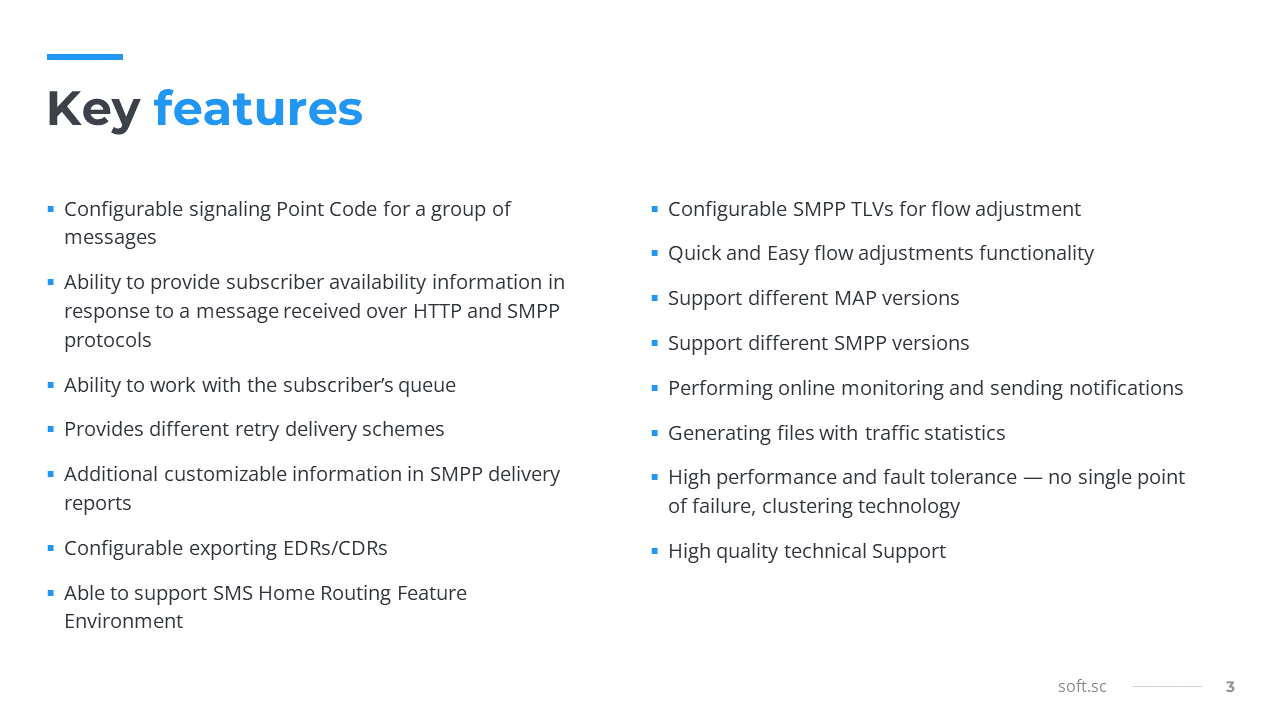
Configurable signaling Point Code for a group of messages
Ability to provide subscriber availability information in response to a message received over HTTP and SMPP protocols
Ability to work with the subscriber’s queue
Provides different retry delivery schemes
Additional customizable information in SMPP delivery reports
Configurable exporting EDRs/CDRs
Able to support SMS Home Routing Feature Environment
Configurable SMPP TLVs for flow adjustment
Quick and Easy flow adjustments functionality
Support different MAP versions
Support different SMPP versions
Performing online monitoring and sending notifications
Generating files with traffic statistics
High performance and fault tolerance — no single point of failure, clustering technology
High quality technical Support
Benefits & Advantages
Reliability
Transit SMSC has a modular architecture. The modules are combined by a single internal messaging protocol and placed on Linux Environment. The minimum configuration uses 2 pieces of computing resources (Servers (bare metal), Instances (VM)) running in the load sharing (Active-Active) mode. All modules are duplicated. If the failure of any module is detected, the routing rules between the platform modules are automatically adjusted. Thus, the failure of some elements does not result in the degradation of the provided service.
Bandwidth and scalability
To increase performance, the platform architecture supports horizontal scaling by increasing the number of clusters/servers joined by a single internal routing system to distribute the load more equally. The multi-modularity and flexible configuration of interactions between modules allow for many different scaling options. The platform divides the processing of both SS7 and SMPP traffic.
Integration
The use of the standard SMPP 3.4/5.0 protocol allows integrating Transit SMSC with various applications, including third party applications.
Uniqueness
In any configuration Transit SMSC, in addition to providing independent SMS delivery and reception status, can be used concurrently with the MNO’s existing SMS centers, retaining the current numbers of SMS centers and all functionalities of the existing equipment. This option is convenient for a quick improvement of the performance of existing equipment with minimum additional service and configuration, which can significantly reduce MNO’s costs of improvement of short message reception/delivery services.

