






SC.STP receives and transmits signaling messages based on their parameter analysis, route availability and other settings of routing rules. In this case it is possible to modify the main message parameters at all levels of the protocol stack.
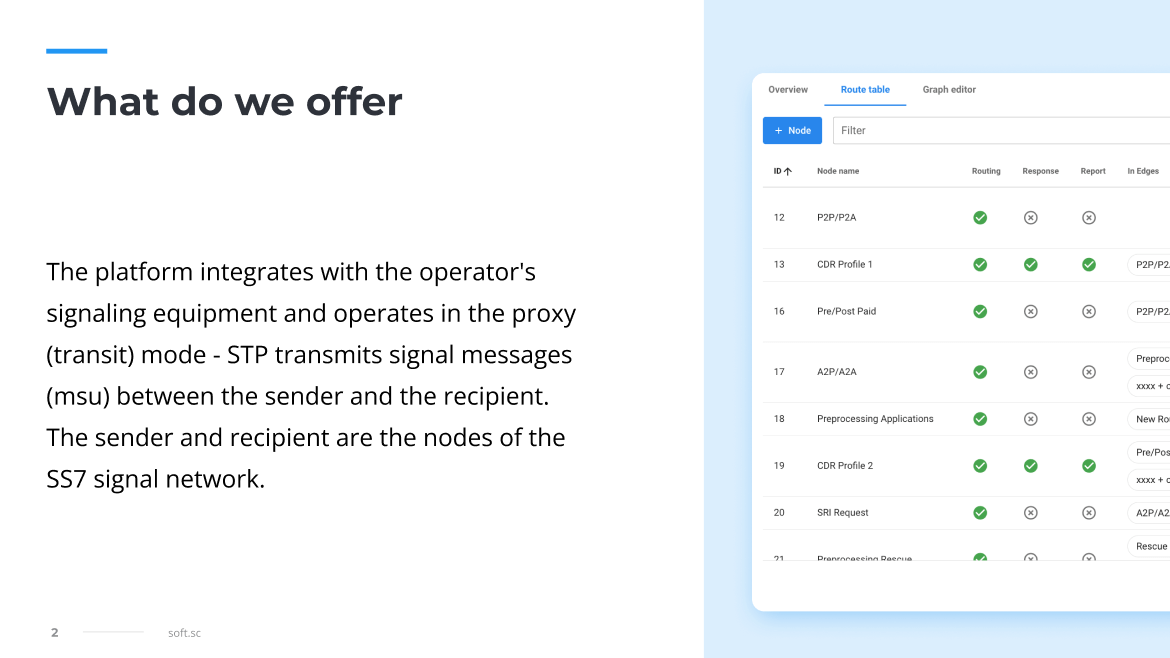
The platform integrates with the operator’s signaling equipment and functions in a proxy mode (Transit) — STP transmits signaling messages (MSU) between the sender and the recipient. The sender and the recipient are nodes of the SS7.
Functionality
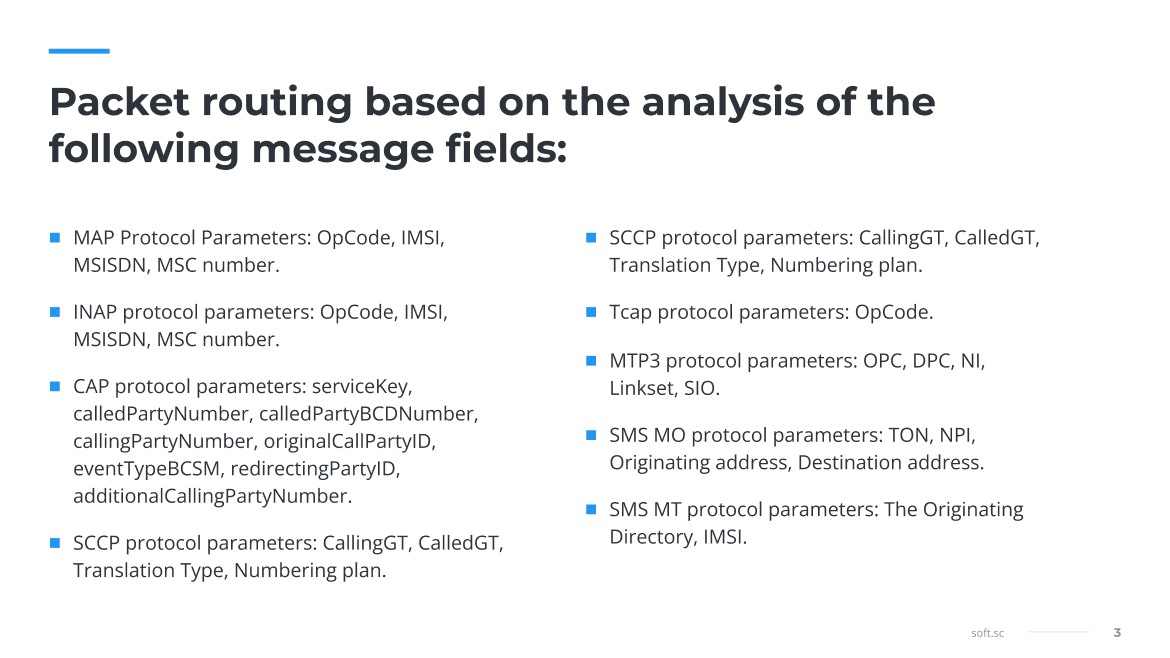
Packet routing based on analysis of the following message fields:
MAP protocol parameters: OpCode, IMSI, MSISDN, MSC number
INAP protocol parameters: OpCode, IMSI, MSISDN, MSC number
CAP protocol parameters: serviceKey, calledPartyNumber, calledPartyBCDNumber, callingPartyNumber, originalCalledPartyID, eventTypeBCSM, redirectingPartyID, additionalCallingPartyNumber
SCCP protocol parameters: CallingGT, CalledGT, Translation Type, Numbering plan
TCAP protocol parameters: OpCode
MTP3 protocol parameters: OPC, DPC, NI, Linkset, SIO
SMS MO parameters: TON, NPI, Originating address, Destination address
SMS MT parameters: Originating address, IMSI
Selecting a scenario for the route (if there are several signal links in the route):
Load balancing between links of the round robin type — each next message is sent to the next link in the set
Sending the message to each link in the set (broadcast)
Link redundancy — if the message cannot be sent to the first link in the set, the next link is checked, and so on
In addition to routing packets, the platform can reject them with a configurable error code (Reject Code/Error)
Option to integrate with other nodes in the signaling network via the following protocol:
M3UA (SIGTRAN)
M2PA (SIGTRAN)
SCTP
MAP v. 1, 2, 3
CAP Category 1, 2, 3, 4 (Routing only, not modification)
SCTP protocol with multihoming support is applied as a transport protocol
Basic parameter modification at all levels of the signaling message stack:
On MAP/INAP level: IMSI, MSISDN, MSC number
At SCCP level: CallingGT, CalledGT, Translation Type
MTP3 parameters: OPC, DPC
Mechanism for detecting and preventing signal loops
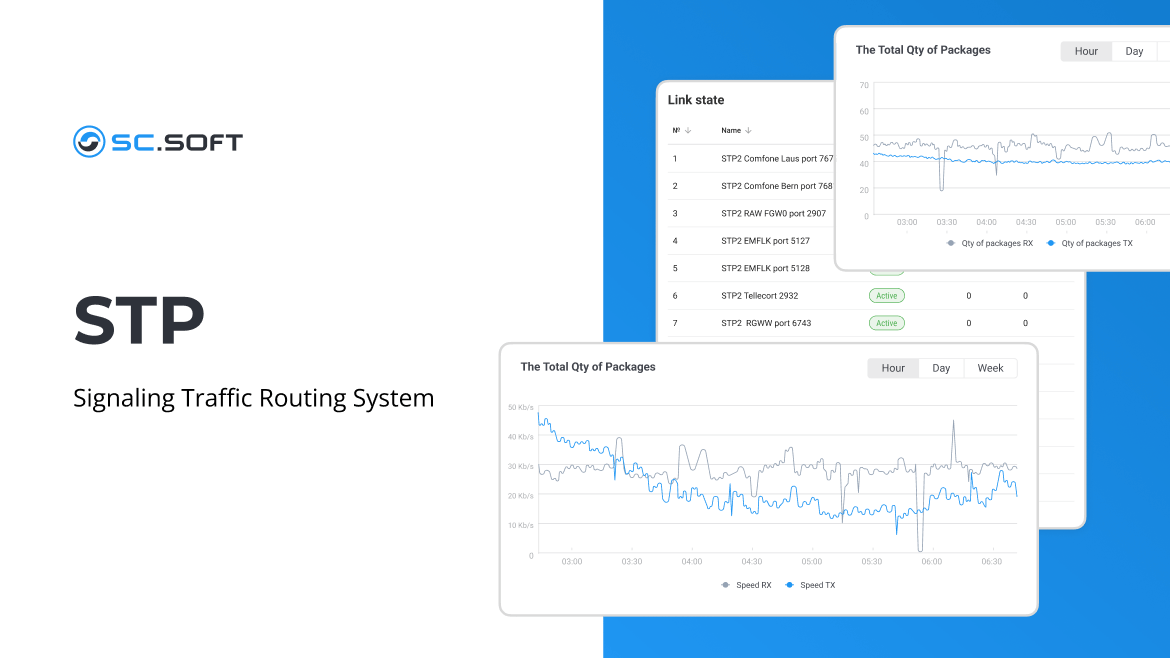
Monitoring of the signal joints status with the option to notify the external system about accidents
Option to store logs of signal message passing, responses to signal messages, system logs
Supported specifications:
RFC 2960, 3286, 4960 (SCTP)
RFC 2719 (SIGTRAN)
RFC 4666 (M3UA)
RFC 4165 (M2PA)
ITU-T Q.704-Q.709, ANSI T1.111 (MTP3)
ITU-T Q.711-Q.714 (SCCP)
ITU-T Q.771-Q.775 (TCAP)
3GPP TS/Recommendation GSM 09.02 Ph1, Ph2, R96, R97, R98 (MAP)
3GPP TS 29.002 R99, Rel-4, Rel-5, Rel-6, Rel-7, Rel-8, Rel-9, Rel-10, Rel-11 (MAP)
ITU-T Q.1218 (INAP), ETS 300 374−1 (INAP-R)
3GPP TS 23.040 (SMS)
Benefits
High performance
Reliability
Flexible scalability
Ability to collect statistics
Option to modify messages
Availability of several operating scenarios with the route
Availability of the administrative web-interface, containing:
information about the status of signaling links
information about the intensity of the transmitted traffic
the option to view MSU data
For integration with the operator’s switching equipment, the platform applies standard protocols
Supports software deployment on virtual infrastructure (VMware, KVM)
High-quality technical support

